



Adhesion G Protein-coupled Receptors (AGPCRs)
Adhesion G Protein-coupled Receptors (AGPCRs)
dhesion G Protein-Coupled Receptors (AGPCRs) are a subfamily of the G protein-coupled receptor (GPCR) superfamily, primarily mediating cell adhesion, cell-cell communication, and signal transduction, playing crucial roles in neural development, immune regulation, angiogenesis, and cancer progression.
The AGPCR family consists of 33 members, categorized based on function into immune-related types (e.g., ADGRE1-5), development and nervous system-related types (e.g., ADGRG1, ADGRL3), and cardiovascular regulatory types (e.g., ADGRA2), all designated with the "ADGR" prefix. A distinctive feature of AGPCRs is their long extracellular N-terminal domain and GPS (G protein-coupled receptor proteolytic site), which enables self-activation via the “Stachel” domain upon external stimulation, facilitating signal transduction.
Dysfunction of AGPCRs is associated with brain developmental disorders, inflammatory diseases, infertility, and various cancers. For instance, mutations in ADGRG1 (GPR56) can cause bilateral frontoparietal polymicrogyria (BFPP), mutations in ADGRE2 are linked to vibratory urticaria, and deficiency of ADGRG2 (GPR64) may result in congenital bilateral absence of the vas deferens (CBAVD). Additionally, GPR56 plays a key role in melanoma metastasis and glioma progression. With advancing research into AGPCR structure and function, this family has become a major focus in the study of neurological disorders, immune diseases, and cancer[1][2].
References:
All Product Categories
-
Adhesion G Protein-coupled Receptors (AGPCRs) Inhibitors
(2)
View all products
-
Adhesion G Protein-coupled Receptors (AGPCRs) Agonists
(5)
View all products
-
Adhesion G Protein-coupled Receptors (AGPCRs) Antagonist
(1)
View all products
-
Adhesion G Protein-coupled Receptors (AGPCRs) Activator
(1)
View all products
-
Adhesion G Protein-coupled Receptors (AGPCRs) Related Products (10)
Related Products (10)

-
(E/Z)-4-Hydroxytamoxifen
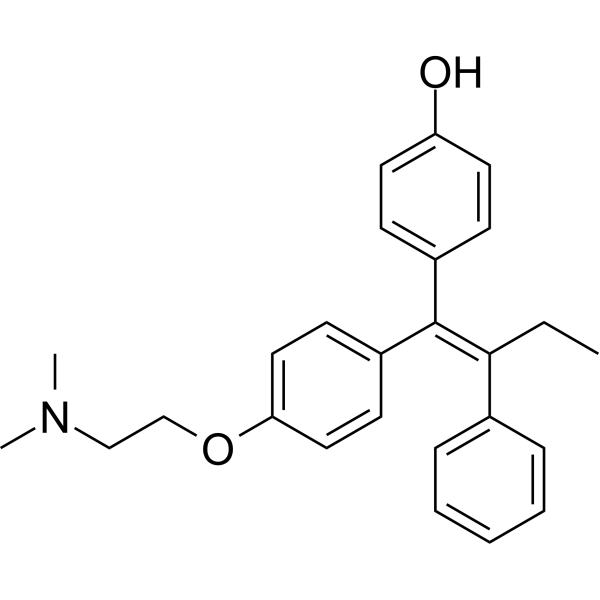 0 ImagesSynonyms: Afimoxifene; 4-OHT(E/Z)-4-Hydroxytamoxifen (Afimoxifene) is a racemic compound of (Z)-4-Hydroxytamoxifen and (E)-4-Hydroxytamoxifen isomers. (E/Z)-4-Hydroxytamoxifen is a selective estrogen receptor modulator with mixed estrogenic and antiestrogenic activity, which is also an active metabolite of Tamoxifen (HY-13757A). (E/Z)-4-Hydroxytamoxifen is an agonist of the G protein-coupled estrogen receptor (GPER) with relatively low affinity (100-1000 nM). (E/Z)-4-Hydroxytamoxifen is promising for research of cyclical mastalgia, such as breast pain, tenderness, and nodularity.
-
AP-503
 0 ImagesAP-503 is a selective GPR133/ADGRD1 agonist with an EC50 of 1.21 nM. AP-503 is used in research on the prevention of muscle-related diseases and vestibular dysfunction.
-
VPM-p15
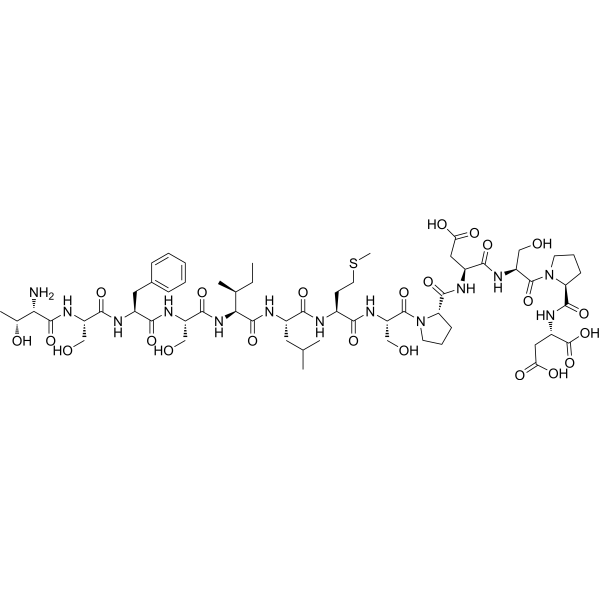
 0 ImagesCat. No.: HY-P10365Purity: 98.25%Vmm-p15 is a peptide agonist optimized for the adhesion G protein-coupled receptor GPR64 (also known as ADGRG2 or HE6). The affinity of VPM-p15 with GPR64 is significantly higher than that of the original p15 peptide. The cAMP level induced by VMM-P15 increased significantly, activated GPR64, and triggered downstream Gs, Gq, and G12/13 signaling. VPM-p15 can be used to study the activation mechanism of adherent GPCR family members.
-
Anti-Mouse F4/80 Antibody (CI:A3-1)
 0 ImagesCat. No.: HY-P990246Anti-Mouse F4/80 Antibody (CI:A3-1) is an anti-mouse F4/80 IgG2b monoclonal antibody. Anti-Mouse F4/80 Antibody (CI:A3-1) can clear macrophages. Anti-Mouse F4/80 Antibody (CI:A3-1) can be used for research on inflammation conditions such as endometriosis. Anti-Mouse F4/80 Antibody (CI:A3-1) often used for flow cytometry analysis and immunohistochemical analysis.
-
Anti-GPR64 Antibody
 0 ImagesCat. No.: HY-P992233Anti-GPR64 Antibody is a monoclonal antibody that targets GPR64/ADGRG2. Anti-GPR64 Antibody can be used in ELISA, FACS, and functional assays.
-
GPR133 agonist 1
 0 ImagesCat. No.: HY-186252CAS No.: 3103571-04-3GPR133 agonist 1 is an orally active GPR133/ADGRD1 agonist with an EC50 of 1.6 nM (293T cells). GPR133 agonist 1 activates GPR133, thereby regulating the downstream cAMP signaling pathway. GPR133 agonist 1 enhances muscle strength and endurance in mice. GPR133 agonist 1 can be used in research related to muscular atrophy, myasthenia, sarcopenia, erectile dysfunction, vestibular dysfunction, obesity, and non-alcoholic fatty liver disease.
-
GPCR antagonist-1
 0 ImagesCat. No.: HY-187424GPCR antagonist-1 is an orally active G protein-coupled receptor (GPCR) antagonist as well as an insecticide. GPCR antagonist-1 induces intestinal microvillus destruction, reduces microfilarial secretion, increases the proportion of malformed embryos, inhibits nematode motility and L3-stage molting, and exerts L4-stage larvicidal activity. GPCR antagonist-1 can be used for the research of filarial infections.
-
PF-07976016
 0 ImagesSynonyms: GIPR antagonist 4PF-07976016 (GIPR antagonist 4) is an orally active GIPR antagonist with an IC50 of 4.1 nM. PF-07976016 (GIPR antagonist 4) exerts its antagonistic effect by competitively binding to GIPR and blocking the increase in Gαs-mediated cAMP production induced by GIP agonists. The combination of GIPR antagonist 4 and Liraglutide (HY-P0014) can enhance the weight loss effect of the single drug. PF-07976016 (GIPR antagonist 4) can be used for research related to obesity and metabolic diseases.
-
(3aS,4R,9bR)-G-1
 0 ImagesCat. No.: HY-107216ACAS No.: 925419-53-0(3aS,4R,9bR)-G-1 is a highly selective G protein-coupled receptor GPR30 (GPER) agonist with a Ki value of approximately 7 nM. (3aS,4R,9bR)-G-1 activates rapid signaling pathways such as intracellular calcium mobilization and PI3K signaling through GPR30, promoting uterine epithelial cell proliferation and exerting antidepressant effects. (3aS,4R,9bR)-G-1 is promising for research of breast cancer and depression.



